Thursday, July 28, 2022

Great Dance, al Fresco


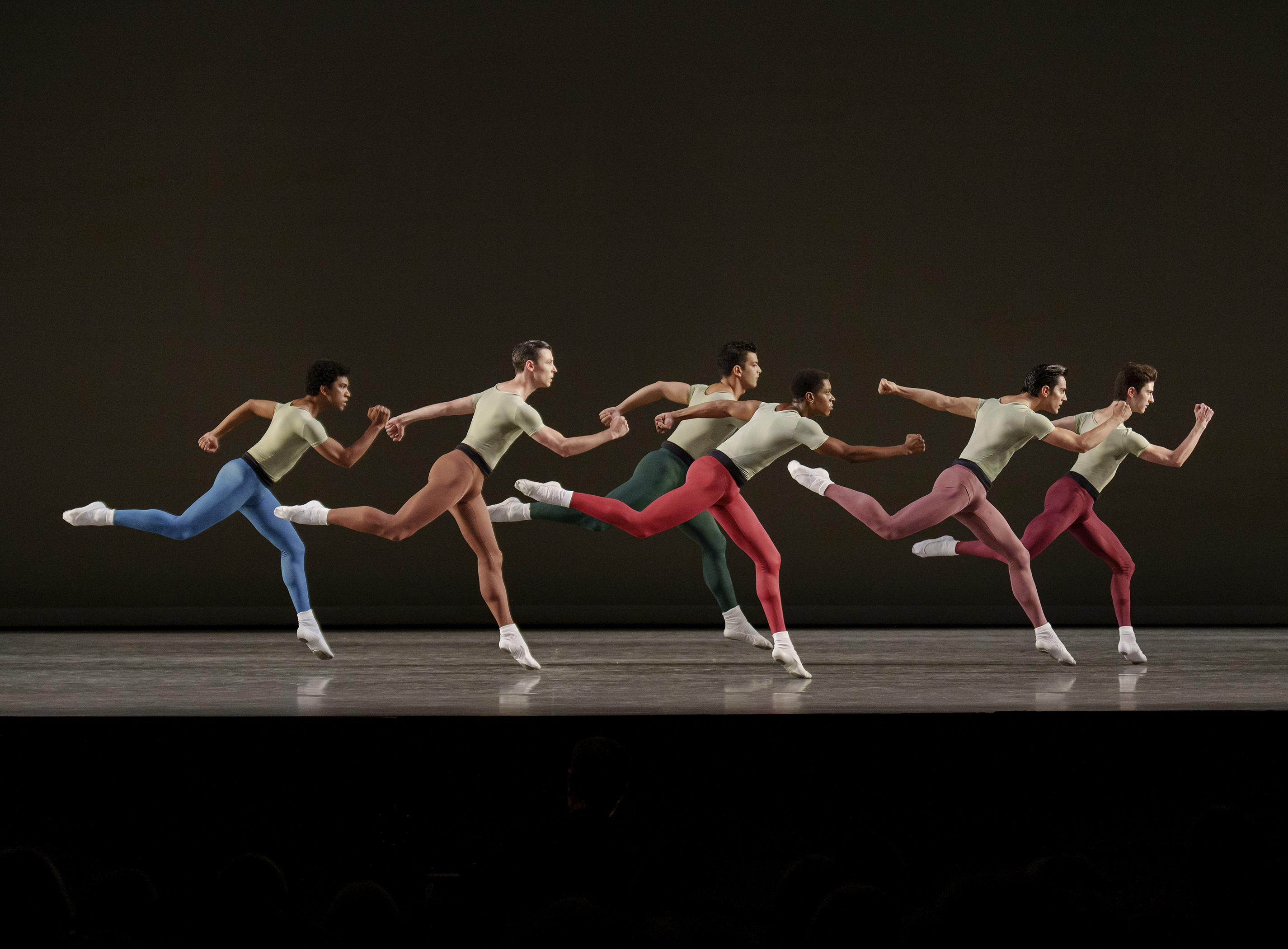
Paul Taylor Dance Company in Syzygy. Photo: Ron Thiele

Summers upstate offer many pleasures—ambient temps, foliage, farm markets, and culture. I took in two dance performances done in open-air, covered amphitheaters: Paul Taylor Dance Company at PS21 in Chatham, NY, and New York City Ballet at Saratoga Performing Arts Center in Saratoga Springs, NY. As with any outdoor venues, weather can be a gamble, but for both events it cooperated.  

Madelyn Ho & Alex Clayton in Airs.
Photo: Ron Thiele
PTDC performed three classic Taylor dances: the uplifting, classical-feeling Airs, the brilliant feat of social commentary, Cloven Kingdom, and the kinetic lab of Syzygy. Often, a familiar slate like this is a chance to observe new dancers in old roles, and this held true in Chatham. Nearly the entire company has changed since pre-pandemic times, so seeing these works with new interpreters was like seeing them anew. This company, as established by Taylor, has always forefronted seniority—the dancers are still listed as such—and turnover was glacially slow for many years. Taylor's passing in 2018 combined with Covid seem to have conspired to catalyze many mid-career dancers' departures. It seemed a bit tragic while it was happening, but the company in its new guise looks strong and far more eclectic. PS21's stage is big enough to accommodate this repertory, and will host Vertigo (of Israel) in a fascinating work called One. One & One, as well as Mark Morris Dance Group in August, plus numerous performances of other genres.

Among the Taylor dancers, Madelyn Ho has emerged as a busy star, featuring prominently in all three dances. Also a doctor, Ho moves crisply and brightly, radiating far beyond her small frame. Devon Louis is also ubiquitous, with a strong bearing and lofty jump. Alex Clayton, also with impressive ballon, seems indispensable. And John Harnage has assumed a gravity to go along with his precision. Some newer faces include the lush Jada Pearman, energetic and ebullient Austin Kelly, and the newest dancer, Kenny Corrigan, a large, swift man, is a welcome bright presence.


Adrian Danchig
-Waring, Ashley Laracey, and Emilie Gerrity in Merce Cunningham’s 
Summerspace.Photo credit: Erin Baiano

SPAC sits a bit north and west. Its stage and vast house were built to Balanchine's specifications as a summer home for NYCB. The campus is vast, with several collonaded or wooden structures housing food vendors, exhibition spaces, etc. You can buy a less expensive lawn ticket and sit and try to watch from afar, although ballet is not exactly a symphony orchestra, requiring far more visual contact. The whole enterprise recalls a prosperous time when many resources were devoted to leisure and elite forms of culture. 


NYCB in Glass Pieces. Photo: Paul Kolnik

The company's run has shrunk to a short week, down from many weeks years ago. I saw a program with Balanchine's Chaconne, Summerspace by Merce Cunningham, and Glass Pieces by Jerome Robbins; another program featured A Midsummer Night's Dream. Not surprisingly, it's a completely different experience than watching in the climate-controlled Koch Theater. As the evening progresses, temperatures sink and breezes kick up. The open side walls permit views of the darkening sky, or impending rain, and you gain an awareness of the totality of the environment and the world beyond the theater. Still, the dance is the focus, and the company showed its stylistic flexibility in this mixed program, ranging from Chaconne's classical ballet with a jazzy flair, the austere modernism of Cunningham softened by Rauschenberg's stippled cyc and unitards, and the urban restlessness of Robbins' stage crossings inspired by Philip Glass' restlessly motivic composition.

Even though I've seen both companies in NYC many, many times over the years, seeing them in plein air settings, surrounded by different, appreciative audiences, energizes my perspective on them and makes me realize how lucky I've been to track their evolution. 

Monday, July 4, 2022

New York Notebook, June 2022


ABT in Of Love and Rage. Photo: Gene Schiavone

American Ballet Theatre

Alexei Ratmansky’s new full-length ballet for ABT, Of Love and Rage, contrasts with some of his recent works, for which he consulted historical documents in order to reanimate some of Romantic ballet’s original vocabulary (as in lower-height limbs in The Sleeping Beauty). Of Love and Rage is a geographical and mythological pastiche inspired by the music of Aram Khachaturian, who may not be a household name in classical music, but has penned some catchy motifs which you’re surely familiar with.

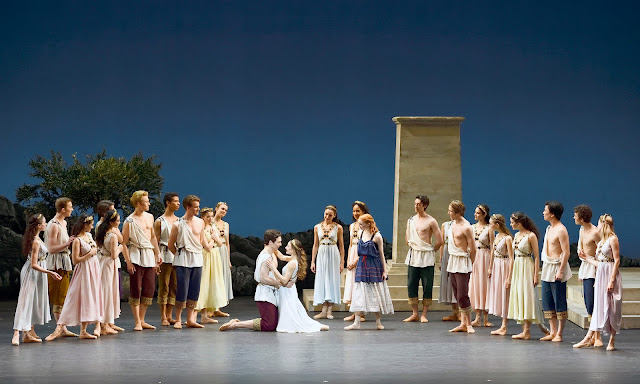
It’s set in and around various locales in the Mediterranean and Eastern Europe, allowing for a dazzling range of costumes by Jean-Marc Puissant which tap into myriad folkloric influences—woven ribbon ceremonial vests; long, fitted coats and tunics; gold border embellishments and chunky jewelry, including silver wrist cuffs in lieu of wedding rings. The plot (dramaturgy by Guillaume Gallienne) essentially follows the great beauty Callirhoe (Christine Shevchenko) as she falls in and out of love, and along the way, in various stages of indebtedness to her suitors—chief among them, Dionysus (Blaine Hoven), Mithridates (Jarod Curley), and the King of Babylon (Roman Zhurbin), three heads of state. She eventually winds up with her first love, Chaereas (Thomas Forster), who had mistakenly left her for dead; they eventualy unite, and with their child as well.

Christine Shevchenko in ABT's Of Love and Rage. Photo: Gene Schiavone

This jerry-rigged plot is often confusing, but it provides a structure for many sections of dance: romantic duets, warring factions, celebrations, and plenty of duos for the lead characters and the demi-soloists who are their friends and/or companions. Forster dances as much with his pal Polycharmus (Gabe Stone Shayer) as he does with Callirhoe. The two men assist one another in swirling, leg-whipping tours, and trade grand jetés (Stone Shayer, a great jumper, matches the taller Forster quite impressively in his loft.) And Callirhoe has an eloquent section with Zhong-Jing Fang as Plangon, a servant of Dionysus, who sees that Callirhoe is pregnant and helps to arrange a marriage to her boss to save face.

ABT’s company looks sharp, with lots of new, intriguing faces, such as Chloe Misseldine (the Queen), who has a dramatic appearance and crisp shapes. Shevchenko possesses a pure technique, with a clarity of line, elegance, and lithe proportions. Forster has superbly shaped feet and is among the most flexible of the men, with perfect splits in leaps, although he could gain some strength for the required overhead lifts. Curley provided a happy surprise; with his long hair and beard, and his credible ferocity, he evoked Jason Momoa.

Ratmansky appeared for the curtain call, and with fellow Ukrainian Shevchenko, hoisted a blue and yellow flag aloft to mad cheers. Of Love and Rage premiered in 2020, long before the war in Ukraine. And yet I thought of Callirhoe, after her initial split with Chaereas—a prize coveted by powerful leaders—as a metaphor for Ukraine itself, the object of a megalomaniac’s desire. If only Ukraine would find a similarly happy ending to an often sad and violent journey.

Pacific Northwest Ballet

Pacific Northwest Ballet performed at the Koch Theater, presented by the Joyce Theater as a resumption of an annual ambitious run of a prestigious company in a larger venue. On June 26, PNB danced works by Ulysses Dove, Crystal Pite, and Twyla Tharp, showing an impressive breadth of style, if with a slightly dated feel.

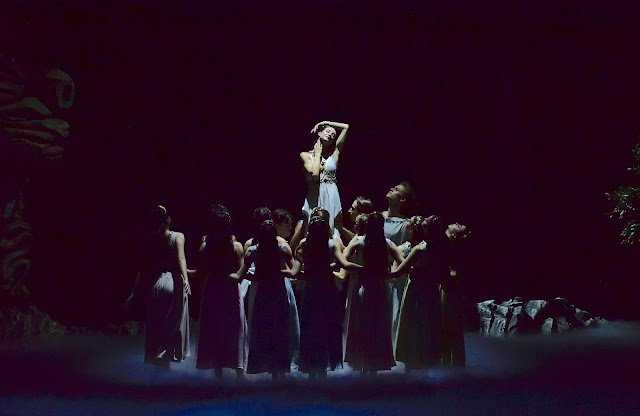
Dancing on the Front Porch of Heaven (1993), by Dove set to Arvo Pärt, features six dancers in striking white unitards (Jorge Gallardo), in geometric shapes of white light (Björn Nilsson) amid inky darkness. The dancers appear as marble sculptures, often striking statue-like poses, their muscles defiant in the raking light. Moments of tenderness emerge—a caged hand covers the heart as the dancer opens his arm wide. Pärt’s compositions are undeniably elegiac and crisply modern, but for a time it seemed as if every dance program included his music, pushing it into cliché. Still, it feels right for this ode made in the time of AIDS.

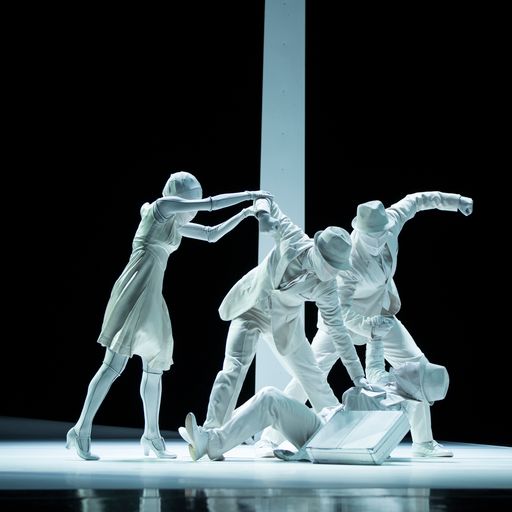
PNB in Plot Point. Photo: Angela Sterling

Pite excels at creating a theatrical event, using movement to tell the story. Plot Point (2010) exemplifies this art, supercharged here by employing the noirish score by Bernard Herrmann for the film Psycho. Half of the large cast wears head-to-toe white, albeit in the form of street clothing (costumes by Nancy Bryant). A narrative involving an affair, a briefcase, a party, and a murder unfolds in many scenes. Episodes featuring ghosts alternate with in-color people, eventually mixing in a confrontation. 

Pite knows how to create organic movement and shapes which delineate the human body’s maximum expression. Her ghosts, however, move somewhat like zombies—stiff necked and crotchety at times. Jay Gower Taylor’s witty sets are simply 2D cutouts of lamp posts, a house facade, and a forest, given dimension through Alan Brodie’s blue and white lighting. It’s a handsome achievement in economy of movement and resourcefulness with materials, riding on an atmospheric foundation of noir music.

Rounding out the bill is Tharp’s Waiting at the Station (2013), an overly stuffed short jukebox dance to music by Allen Toussaint. While there are a few moments of focused quiet, most of the work features the corps dancing manically upstage. Rather than acting as a backdrop for the lead characters downstage, they tend to distract from and obscure the storytelling, such as it is. A father (James Yoichi Moore) is trying to bond with his son by passing along his dance knowledge (Kuu Sakuragi) before succumbing to the Three Fates (three Amazonian women in gold, more Vegas act than omens of death). 

James Moore in PNB's Waiting at the Station. Photo: Angela Sterling

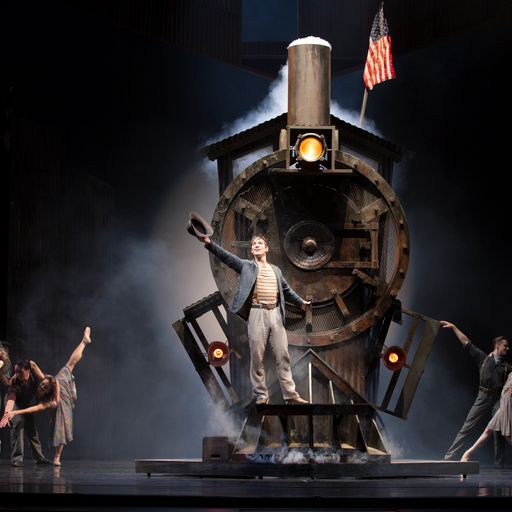
Toussaint’s music, from jazz jam to pop song, evokes the New Orleans setting, and Tharp employs the Broadway style of her wide-ranging choreography to keep things lively. The finale features a locomotive rolling downstage, apparently the father’s ride to the great beyond. While the prop depicts just the train’s front, the fairly complex piece of sculpture is seen for a few minutes—in stark contrast with the concision of Taylor’s sets for Plot Point

PNB’s sheer talent and versatility on a large scale is on display in this program. Perhaps it needed at least one newer work to represent the current moment.

Monday, June 20, 2022

Conjuring Art from the Quotidian

Lisa Borres & Devon Louis in Fibers. Photo: Ron Thiele

Words alone have meaning, but only when strung together do they truly mean something.

That’s the takeaway from seeing Paul Taylor Dance Company’s program on June 14 at the Joyce. Artistic Director Michael Novak has smartly programmed some of Taylor’s early dances, such as Fibers and Images and Reflections, in which the choreographer experimented and sketched out seminal shapes and ideas to form an essential vocabulary from which he drew to create paragraphs. These precede later major pieces, also performed—Profiles, Aureole—which assembled these motifs in dazzling phrases to make an incomparable body of modern dance.

The program differed greatly in feeling from the company’s recent spring stint at City Center’s Spring Dance Festival, which featured mostly romantic or classical dances—soothing in a time of chaos, but not wholly representative of the choreographer's breadth. (Taylor, who died in 2018, often included one crunchier dance, either a psychological study or social commentary, 
in an evening of three pieces.) The early works seen at the Joyce are mostly shorter, or excerpted, eschewing the three-dance-per-evening formula (be it tried and true). The four Taylor dances bookended a premiere by Michelle Manzanales, a reminder that while rooted in Taylor’s oeuvre—ever more distant with each passing year—the company must continue to look ahead.

Taylor collaborated often with designers, including well-known artists. Rouben Ter-Arutunian created the fantastic contraptions and garments for Fibers (1961). The mens’ are the focus—colored and white straps encircling limbs and torso, hockey goalie-type face masks concealing the face, thus redirecting attention to the whole body. The women’s faces are painted white, to match the white unitards with blue details. While the piece forefronts the movement’s drama, enhanced by the costumes, it drops key shapes and moves that emerge in Profiles and Aureole.

John Harnage in Images and Reflections. Photo: Ron Thiele

Robert Rauschenberg contributed costume designs for Images and Reflections (1958). The first two evoke underwater creatures, especially in the dark lighting scheme—John Harnage, whose lucidity has emerged even further alongside confidence and strength—sports a long white mane on his unitard; Kristen Draucker wore a skirt of fin-like pink panels. Devon Louis (busy guy, in all but one dance on the slate) wore silver panné head to toe. The dancers made clear shapes, moving from pose to pose, or between short phrases, which were detached from the Morton Feldman score. Lyrical, arcing arms could be spotted in Aureole; explosive jumps in Profiles, to follow.


Madelyn Ho, John Harnage, Alex Clayton, Eran Bugge in Profiles. Photo: Ron Thiele

Profiles (1979) is a brief but daring study in extreme partnering. Beginning in his flat, Greek vase style—in profile—it evolves as the two pairs do what looks to be impossible. A woman, assisted by her partner, leaps onto his shoulder like a cat, or bounces high off of his chest. The two pairs form a lattice, the women balancing on the mens’ thighs. Profiles shows the potential of partnering beyond a pretty lift, and the steely strength required not just of the men, but the women.

In Aureole (1962), Taylor seemed to have taken all these striking shapes and strung them together with fluent connecting phrases, set to melodic Handel. Gone are the arty costumes, replaced with classical, crisp white leotards and dresses. Taylor’s new classicism took root in Aureole. However, it wasn’t a total break from the conceptual experiments into which Taylor had delved, nor the high drama of his days as a dancer with Martha Graham. He would also pursue these threads in his widely varying body of work, which still defies easy definition.

Hope Is the Thing with Feathers. Photo: Ron Thiele

Manzanales choreographed a premiere, Hope Is the Thing with Feathers, a suite set to a range of songs about birds. It’s fun, jaunty, and the dancers seem to be enjoying themselves. It is no cakewalk to be juxtaposed with prime examples of Paul Taylor’s choreography, but she acknowledged a debt to his influence by inserting Taylor quotes now and then—the arced, flowing arms, certain shapes and leaps. Then again, he created so many dances, and so many kinds of dances, that his influence can be found if you simply look for it in much of the work created in his wake. Even just walking down the street.

Concurrent with the PTDC Joyce run, Gladstone Gallery ran two shows of early work by Rauschenberg (and one at Mnuchin, which I missed). As is often the case in New York these days, the shows were of museum quality. Many of the works are made of cardboard and found objects—tires, paper bags, bikes, furniture, muslin. While watching the early Taylor work, I couldn’t help but think how, in the right hands, the simplest materials or human shapes ordered a certain way can become enduring art. How providential to catch displays by these collaborators at the same time.

Wednesday, May 18, 2022

L.A. Dance Project's Boldness Becomes the Norm


Solo at Dusk.
Photo: Josh S. Rose

By Susan Yung

“The ground was soft, and so were they. Flowers grew over their faces.”

      —Bobbi Jene Smith and Or Schraiber,
         Solo at Dusk

L.A. Dance Project, now a decade old, continues to be led by Benjamin Millepied, who returned after a brief stint at Paris Opera Ballet. Millepied was previously a principal at New York City Ballet, and several other alumni populate the LA staff, including the polymath Janie Taylor. At the Joyce recently, LADP presented two programs choreographed by women. I caught Program B; A included works by Bella Lewitsky and Madeline Hollander.

Bobbi Jene Smith’s Solo at Dusk (2020) captures the solitude and oppression of the pandemic, even while its seven performers cluster, interact, and dissipate on the Joyce stage. Each dancer wears a stunning baroque floral mask by Janie Taylor, who in addition to designing costumes, sets, and dancing, is also rehearsal director and choreographer for the company. As the lights go up, we see a table with a turntable and lamp, next to which sits a masked Taylor (unmistakable for her waist-length hair, a signature from her days with New York City Ballet). Dancers trickle in, performing a quirky, frenetic version of Gaga—hunched skipping, pelvis-first struts, bursting leaps between placid stances, big spins in attitude.

The movement is largely performed solo; in one scene, the other six dancers form columns to observe one another. Eventually, they form a circle, grunt, and chant, moving as an ensemble. Two “converse” through movements, and in a mock sparring match, a woman arches over a man’s back. Near the end, they each hold their heads and remain alone, distanced. The soundtrack, by Alex Somers, ranges from ambient sea sounds; a song delivered chanteuse-style; plangent, rhythmic vamping; to an instrumental reminiscent of Twin Peaks. The mood is consistently melancholic and the performers are committed, but it is an elegy to a time most of us would like to forget.

Daisy Jacobson, Nayomi Van Brunt in Night Bloom. Photo by Steven Pisano

Janie Taylor’s Night Bloom, in contrast, provides joy in vibrant, unfettered movement. The cast plays with her inventive set pieces—large geometric objects evoking ice cream sandwiches, moved around constantly like building blocks. Performed to Stravinsky’s Concerto For Two Solo Pianos (played live by Jessica Xylina Osborne and Adam Tendler), the dance mirrors the playful give and take of the music. Taylor’s costumes—short navy shifts for the women, light blue tees and shorts for the men—add to the youthful atmosphere, luminous with vanilla-hued lighting (Chu-Hsuan Chang). The choreography is a fresh mashup of balletic poses and structures with a sometimes relaxed attitude, dispensing with precise hands and arm positions, but also more technically demanding steps such as corkscrewing double tours en l’air, creating a tempestuous feel.

LADP is one of the few repertory companies in the US founded as such, and commissioning new work by a variety of choreographers. It sits alongside such titans as Martha Graham, Alvin Ailey, and Paul Taylor’s companies, which in order to remain relevant, now commission premieres to be shown alongside their founders’ wares. Kudos to LA’s Millepied for ceding the lion’s share of stage time to innovative and/or historic women choreographers, now proving their talent.


Tuesday, April 5, 2022

Spinning Webs and Seeing Art History in a New Light

Free the Air. Photo: Susan Yung
Years ago, I went to a wedding where I knew almost nobody. It took place in a beautiful setting next to a marina. I walked down a dock, and found a spider spinning a web. I watched as it toiled away, making a beautiful net out of gossamer silk. Perhaps it was the way the sunlight glistened on the water caught on the threads, or the extremely methodical process by the spider to make cross braces, or the fact that I was somewhat distant from the wedding party itself and found something on which to focus… in any case, it made a deep impression on me.

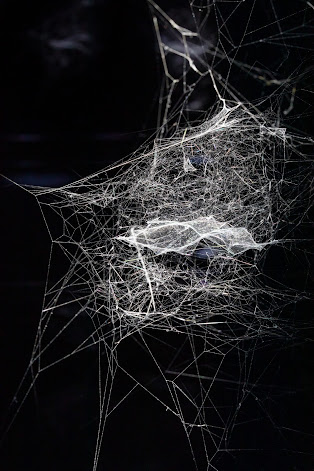
Clearly I wasn’t alone, as evidenced in Tomás Saraceno’s interactive installation Free the Air: how to hear the universe in a spider/web, part of his show, Particular Matter(s), at The Shed through April 17. Saraceno has suspended pseudowebs in the vast space—vibrating metal mesh platforms, embedded with sound amplifiers, imparting an eight-minute interpretation of what spiders experience. The performative element is enveloping—after entering an all-white, foggy space and lying down on the undulating platform, you’re enfolded in darkness, and begin to feel waves of energy and hear booms and hisses—"terrestrial and cosmic vibrations, including spiders playing their webs," per The Shed. At moments, the energy undulations threaten to develop into stomach-churning strength before waning. And then it’s over.


Tomás Saraceno,Webs of At-tent(s)-ion(detail), 2020.
Seven spider frames, spider sil
k,carbon fibers, lights.
Photo: Nicholas Knight. 
Courtesy the artist; spider/webs;
Tanya Bonakdar Gallery, New York/Los Angeles; and 
Neugerriemschneider, Berlin. Photo courtesy The Shed
The performance’s brevity, alas, is somewhat overshadowed by the procedures required to access it. It’s kind of like going to Disneyworld, where you have to park, trek, pay (tickets go from $35 for the experience, down to $12 for exhibition access for non-members), and wait on line before reaching "the experience", which lasts for only a few minutes. The day I went, I thought I’d hit the jackpot with the weather—in the 50s and not raining. But Hudson Yards is amenable only on the best of days, and despite the mild temps, the wind blew mercilessly. Navigating to the exhibition’s entrance is circuitous and a bit mysterious, after which you ascend on escalators for a few stories. After queuing outside the installation, you’re led into an antechamber/locker room and instructed on what not to do (run), and stow your stuff in a locker, then led into another antechamber and stairway to wait again before entering the space itself. I understand these are all necessary for safety and crowd control (though to be clear, the groups are very small), but it still overpowers the actual event.


Speaking of being overshadowed, there are two galleries with incredible installations to flesh out Saracen’s concepts. One gallery contains sculptures in plexi boxes—structures that have apparently been fashioned from filaments on which spiders have spun webs, and another room with an intense light beam which catches dust motes and floating junk to create an alarmingly solid-looking shaft of stuff we breathe. On the floor above sits Museo Aero Solar (made by a collective including Saracen), a gigantic inflated bubble, made of discarded plastic bags and detritus, which you walk into. There are a number of other works that reflect Saracen’s vivid sense of curiosity, devotion to nature and its preservation, and poetic touch. (That said, the signage and guards/docents posted could be more helpful.) 


Installation view at Frick Madison of Giovanni Bellini’s St. Francis in the Desert (ca. 1476–78).
Photo: Joseph Coscia Jr.

The Frick has relocated some of its trove to the Breuer Building on Madison Avenue, the old Whitney/Met space. What a trip to see the Rembrandts, Fragonards, Goyas, and Turners hung in the context of crisp modernity. While the pre-Meatpacking relocation bickering over the Whitney’s expansion lingers in memory, the Madison Avenue building always was just the right temperament and size for a museum visit. Take the elevator up, walk down while visiting each floor, and always check on the little stairway pueblo installation by Charles Simonds, which is still there! 


For many my generation, the Frick’s collection is like a real-life installation of Janson’s History of Art, the ubiquitous if flawed art history textbook, once considered a bible. The foundations of Western modern art, and the continued primacy of this legacy in the most popular museums, are seen on the Frick’s walls, and in part because of the rote drills I underwent to absorb this canon, many of the works evoke reflexive awe. Rembrandt’s Polish Rider! Bellini’s St. Francis in the Desert! The Fragonard suite! And the Frick has included some contemporary works in a somewhat pale effort to modernize the art collection, a highlight being Giuseppe Penone’s series of shield-sized porcelains embellished with his fingerprint whorls. 


But while the Frick's home at 1 East 70th St. continues to be renovated, the Madison Avenue space is a wonderful solution to keep some of the collection on view, while making use of a still sturdy museum shell. After the collection moves out, we'll see what happens with the Breuer.

Wednesday, January 5, 2022

Notable Books of 2021

Some notable books I read in 2021, and one documentary:

Novels:

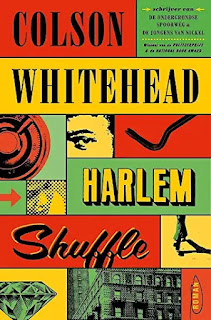
Harlem Shuffle, Colson Whitehead
Engaging novel about aspiration, hard work, racial inequity, and the weight of family bonds, amid the three-ring circus that is New York.

O Beautiful, Jung Yun
A biting account of an Asian-American journalist who returns to her Plains roots to find a new gold rush, with all its mostly troubling implications.

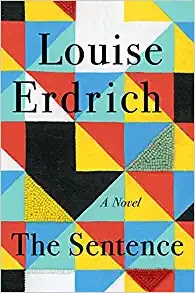
The Sentence
, Louise Erdrich
The title has two wildly disparate meanings. Books become a haven, Erdrich has a cameo, and current events are woven throughout.

Intimacies, Katie Kitamura
I wish the title were less romance-novel sounding… about a war crimes trial translator at The Hague, and the complicated and haunting layers therein.

Razorblade Tears, S.A. Cosby
Just when you thought things couldn’t get any crazier for the protagonist, resisting being dragged back into crime, and then… what’s the word? Unputdownable.

Bewilderment, Richard Powers
A tender, heart-achingly poignant portrait of a dad and his special needs/gifted son, and the beauty and cruelty of nature.

Damnation Spring, Ash Davidson
Focusing on a family in a logging town, it addresses tough issues like rights to natural resources and corporate responsibility over profits, which communities everywhere are dealing with
The Final Revival of Opal & Nev, Dawnie Walton
A 70s pop duo’s unlikely and complicated history, leading up to a reunion, told in rich detail and characterization.

Cloud Cuckoo Land, Anthony Doerr
Skips across time and culture with borderline hubris, while framing a nail-biting, modern-day terrorist scenario.

The Morning Sun, Karl Ove Knausgaard
He captures daily life and human nature so poetically—both the lovely and ugly. With overlapping story lines and recurring threads of new stars, climate change, the tension between society and nature, and eternal existential questions (though the ending treatise is a bit heavy-handed).

Literary thrillers:


I read these nearly back to back, and could not believe how gripping plots could be which involve authorship and literary proprietariness, nor how “of the moment” they were. Describing plots might spoil things.

The Plot, Jean Hanff Korelitz

Palace of the Drowned, Christine Mangan

Who Is Maud Dixon?, Alexandra Andrews

Biographical/documentary:


Making Rumours: The Inside Story of the Classic Fleetwood Mac Album, 
Ken Caillat & Steven Stiefel
This was one of my first and most-played albums as a teen, and with Spotify at hand, you can listen to each track as its creation unfolds. Plus, the high drama of Fleetwood Mac.

The Storyteller, Dave Grohl
I guess Dave is as surprised as anyone that this is a best-seller, but an entertaining and (no surprise) friendly read about how a typical kid becomes part of rock legend—twice.

Swan Dive, Georgina Pazcoguin
Lots of surprisingly candid dish about the backstage workings of New York City Ballet, by a current company member who has seen it all.

Get Back, Peter Jackson (documentary on Disney+)
This nine-hour trilogy is so resonant and illuminating that it is impossible to stop thinking about. It brings The Beatles back down to earth from their saintly perches, but without casting villains, and captures some of the studio magic and plain old genius needed to craft a broad and foundational output.


Happy 2022!

Sunday, November 14, 2021

New York Notebook, Fall 2021

American Utopia. Photo: Matthew Murphy

There’s no better season than fall in New York. Upstate, the evolving, brilliant outdoor theater of the trees and mountains after the verdant lushness of summer. In the city, the torrent of culture that all seems to happen in October. This year, things in NYC have moved closer to normal, with regular capacities at theaters, restaurants, and museums. New Yorkers have gotten used to masking up inside, and showing proof of vax-plus-ID everywhere. Just more layers necessary to access the fruits the city has to offer.

Nothing better represents the joy of returning to near-normal life than David Byrne and his Broadway show, American Utopia (reviewed here in 2020). It celebrates Byrne’s music, framed by Annie-B Parson’s movement, in the purest form, featuring only the incredibly talented cast onstage with no props other than instruments and a metal beaded curtain. Byrne himself, in his late 60s, is seemingly ageless, showing no signs of fatigue or being winded, even after belting out one of his many timeless hits. He has put forth his ideals not only by speaking or singing them, but by example. How many rock stars ride their bikes everywhere, mixing with the public at large with a friendly demeanor? The show has moved to the St. James Theatre, and retains the hypnotic kinetic invention of Parson, with marching patterns and simple moves and gestures done by musicians and the two dancers alike dressed in dapper grey suits. And Byrne, of course, barefoot, bolstered by devoted audiences.


João Menegussi and Calvin Royal III in Touché


American Ballet Theater’s ABT Rise initiative shows its full-out commitment to diversity, equity, and inclusion. Their program contains a “Land Acknowledgment” statement, stating that they perform on land stolen from Indigenous peoples. I attended the Oct 22 performance at the Koch, one dedicated to the LGBTQIA+ community. The mixed rep program contained many traditional-feeling works—Alex Ratmansky’s showcase of young technical virtuosity and exuberance, Bernstein in a Bubble; Clark Tippett’s Some Assembly Required, a largely quiet psychological drama danced by newly promoted Skylar Brandt (who dazzled in the Bernstein, at one point pirouetting what must have been six revolutions) and charismatic Gabe Stone Shayer in a toned-down role; and Indestructible Light by Darrell Grand Moultrie, an entertaining, jazzy crowd-pleaser full of maxed out moves and poses. It also showcased Touché by Christopher Rudd featuring Calvin Royal III and João Menegussi, who underwent a mutual coming-out told through increasingly intimate movement and garments shed. 


The company is undergoing a seismic leadership change with both the artistic director and executive director departing, in addition to the shift toward diversity which is so urgent at most organizations now. How it deals with its core programming—full-length ballets, many centuries old, with politically incorrect themes, motifs, and actions—will unfold in the coming seasons, beginning with next year’s presumably shorter-than-usual run at the Met Opera House. Its concurrent contemporary choreographic commissions have run the gamut (I missed the Jessica Lang suite to Tony Bennett) which, from its sheer breadth, will likely produce hits and misses. Will there be a larger shift in the spring/summer season from centuries-old chestnuts to contemporary work? We’ll see.


Charmion von Wiegand, Untitled, 1942

While I’m sure it wasn’t meant this way, the sheer physical relationship at the Whitney Museum between Mind/Mirror, the mega Jasper Johns half-retrospective on 5 (the balance is at the Philadelphia Museum) and the keen survey, Labyrinth of Forms: Women and Abstraction, 1930–1950, occupying the 3rd floor small gallery speaks volumes—iconic white male artist physically dominating the building while the women are exiled to a space adjacent to the restrooms. The latter exhibition comprises works from the Whitney’s collection, most of who are unfamiliar names. Work by Barbara Olmsted and Dorothy Dehner sits alongside those by Lee Krasner and Louise Nevelson. It’s a thrill to “discover” so many women who worked in abstraction during a time that preferred realism, at times organizing to support one another. The taut show was organized by Sarah Humphreville, Senior Curatorial Assistant.


Unsurprisingly, the Johns show contains many of his landmark works—flags, maps, coffee cans. The Whitney has many of Johns’ 1980s-90s pieces, which evoke stasis and marking time. Some of Johns’ works which struck me most strongly are actually his more recent ones, black & white ink on plastic (Matthew Marks Gallery had a show including many of these.) Perhaps because Johns, now in his 90s, has worked constantly for most of his life, producing an enormous body of work tracing so many subgenres, it is easy to take him for granted. But his influence is incalculable even if he and his male counterparts may have hoarded due attention to their female peers.

Shirazeh Houshiary, Pupa, 2014
The Asia Society’s Rebel, Jester, Mystic, Poet exhibition is an eye-opening survey of contemporary Persian (Iranian) art. It encompasses a breadth of styles and an impressive refinement of techniques and visions. Some names are familiar—Shirin Neshat, Abbas Kiarostami—but most are new to me, and many offer revelatory creations. Morteza Ahmadvand’s three-channel video installation plus sculpture traces three religious emblems as they morph into spheres. A spiraling stack of amethyst glass by Shirazeh Houshiary mesmerizes.

Several artists use traditional craft and techniques as a means to convey contemporary messaging infused with cultural legacy. Farhad Moshiri's carpets cut into the shapes of fighter jets; Afruz Amighi's scrim of polyethylene (a material used in refugee tents) contains intricate, lacelike imagery which, despite its poetically delicate appearance, turns out to be terrifying; Shiva Ahmadi paints oil barrels with lavish, rich scenes associated with traditional miniatures and ornate imagery. The works possess great craft in addition to powerful messaging, often simmering below the surface of traditions carried forward.

That an ancient culture, and culture in general, can be so vital and relevant offers some welcome hope in a time of flagging optimism.
Photos: American Utopia: Matthew Murphy; ABT: Rosalie O'Connor; Von Wiegand: courtesy Whitney Museum; Houshiary: Susan Yung