Thursday, November 23, 2023

Fallen Trees Find New Life in Art


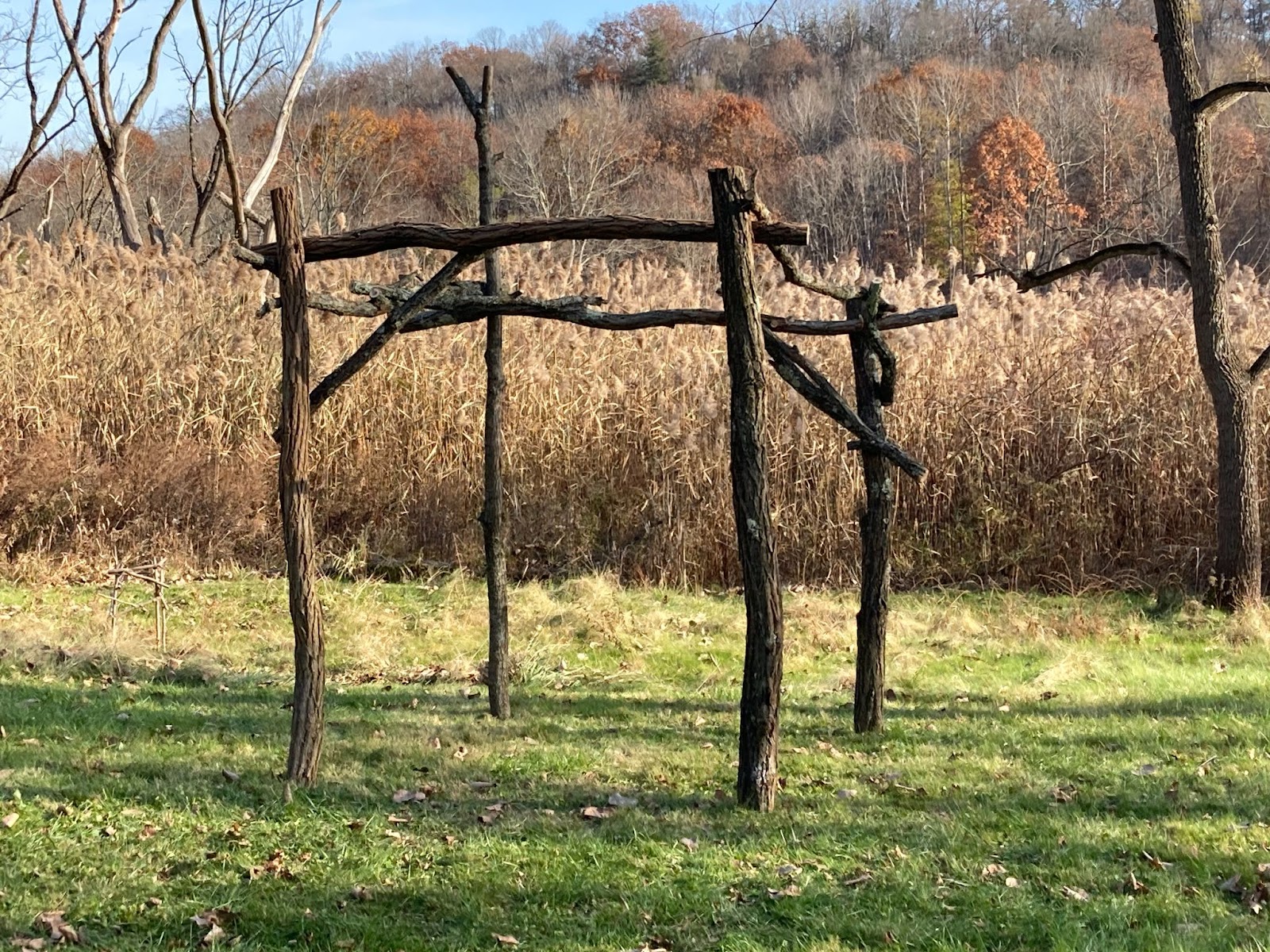
The final sculpture


My friend Bob Bangiola, an artist in Hudson, asked me to help him construct a sculpture in his back yard, which overlooks a vast, marshy expanse. He uses found wood—tree limbs, branches, and trunks—to connect post-and-lintel frames to make rudimentary edifices. At maybe eight feet tall, this was among the largest Bob has made; other works in his yard are about three feet tall.

The process entailed Bob positioning two primary, pre-constructed frames an appropriate distance apart to eventually form a rough cube. He then hoisted and tilted one upside-down “U” frame perpendicular to the ground. This is where I came in (plus a bit later, two people who were filming the process for a documentary). I stood by one post and helped position it to the point of zero gravity, as Bob checked in with me by voice, look, and balance so that both sides felt weightless. He used the phrase "tuning fork" on occasion, an apt term for the process of refining the work's balance through the most minute adjustments. 
To help keep one of the two main frames in place, Bob used a separate limb with a forked end, like a crutch, to prop it up. To support the other frame, he parked his Jeep against it to take its weight. He then positioned cross bars between the two frames, plus braces to make triangles, and drove in lag bolts to stabilize it.
A crutch-like branch and the Jeep support the frames 

Because of the nature of how trees grow, some of the tree lengths have slight twists and bows, so when they are positioned as crosspieces, they might rock or pivot. The differing density and heft of various woods is surprising. Each piece has its own characteristics that need to be factored in. As the work ages, it will settle.When the framework was stable enough to stand alone, Bob pushed and pulled on various parts to test its strength. He hung from the cross bars and pulled up his weight, bouncing to test its stability.Eventually, the structure will most likely collapse—most of the wood was dead to start with. But the process of decay and dissolution is part of the artwork. The piece evokes many things: shelter, a gate or passageway, a playground or acrobatics apparatus, to name a few—each viewer will form their own associations. For now, these fallen trees live anew.

Photos: Susan Yung

Wednesday, November 15, 2023

Sobelle's Enticing, Gluttonous, Enlightening FOOD

Geoff Sobelle, exemplary waiter. Photo: Stephanie Berger

Geoff Sobelle taps into just every imaginable topic surrounding FOOD, the title of his latest theater work. These range from how city dwellers most often encounter it—in a restaurant, accompanied by wine—to its consumption by a gluttonous waiter after his shift, to the origin of wheat crops that have come to signify Big Ag and the ensuing destruction of the American landscape and diet. 

Sobelle is as polite as you’d expect a waiter to be in a fancy establishment, albeit with a 300-square foot table. He enlists those at the table (most of us sat in surrounding seats) to pour wine and read aloud from cues written in menu folios, or answer questions such as “what is your favorite diner food?,” and then magically produces said meal (meatloaf and mashed potatoes). After his shift, he consumes the leftovers and whatever else lies around—apples, raw eggs, tomatoes, salad, a steak, a fish, two bottles of wine, the leftover meatloaf, then cigarettes and money. It’s a pretty convincing act that leaves you wondering what trickery he used, because he simply can't have consumed all that!


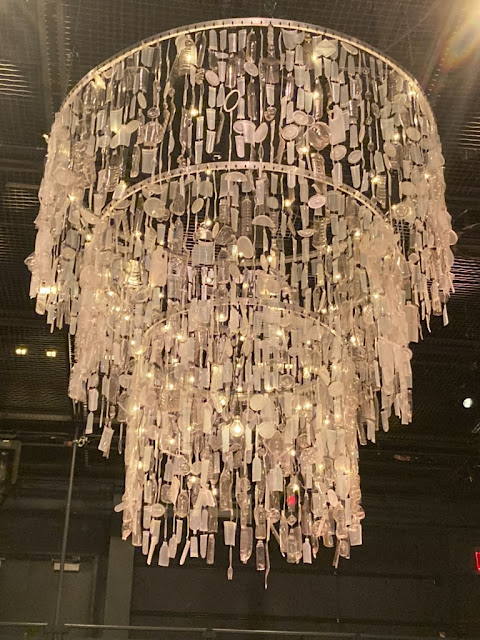
Chandelier, recycling bottles and stuff. Photo: Susan Yung


In another trope of magic, he yanks off the enormous tablecloth (it sits beneath an elegant, tiered chandelier made of recycled items), revealing a plain of dirt. Shifting gears, he crawls around the dirt on all fours, plucking adorable little bison out of the dirt, moving them foot-by-foot around the plain in an expanding herd. Following a tiny tractor that self-drives across the field, sheafs of wheat grow. Sobelle plunges his arm deep into the earth and retracts it, covered with oil. Derricks and rigs pop up, model houses are placed willy-nilly by the diners from passed trays, and high-rises with interior lights emerge from the soil. 


Post-shift imbibing. Photo: Stephanie Berger


The bison are returned to the earth, now extinct, and Sobelle himself digs a plot and disappears into the ground—the final feat of magic. We’ve experienced nothing less than the history of America in a physical re-enactment, as well as the endgame of late-stage capitalism and gluttony in its rawest form. FOOD is the third in a trilogy presented at BAM, with previous shows based on hoarding (The Object Lesson) and the complexities of a domicile (HOME). 


It's also the most demanding for Sobelle himself, the key element  powering his entire extremely popular theatrical enterprise. One wonders long he can continue to throw body and soul into his works, but in the meantime, there's no one else like him.


FOOD, BAM Next Wave, BAM Fisher, Nov 2—18, 2023


Thursday, August 31, 2023

Hanging Dance on Frames of Fiction and Technology


Maya Lee-Parritz and Jodi Melnick in Água Viva.
Photo: And Or Forever (Carr Chadwick & Kate Hawkins)

Água Viva
, by Jodi Melnick and Maya Lee-Parritz
Hudson Hall, Aug 27, 2023

“You don’t understand music: you hear it.
So hear me with your whole body.” 
     Água Viva, by Clarice Lispector

Maybe it was best to overlook, on purpose or coincidentally, that the sublimated foundation for Jodi Melnick and Maya Lee-Parritz’s Água Viva is the same-titled book by Clarice Lispector. There’s no apparent plot in the dance, and none to be obviously deduced from the movements—live and on film—that fill an hour. Better to absorb their deceptively simple phrases and gestures; distances, proximities, and duets; and synchrony (or lack thereof) with the sound score, by Jon Kinzel.

Melnick’s movement continues to be entrancing, filled with delicacy, fluidity, and rationale. Her hands make idiosyncratic shapes, contrary to the rote ones ingrained in many dancers from years of ballet training—tensile flexions or oddly skewed fingers. For the middle section, she dons clunky, heeled oxfords, clomping around on stage. Lee-Parritz dances with a boldness and accentuation that simmers below a very coordinated surface. She looks directly at us with the hint of a knowing smile. Her thigh-length braid whips around her body; Melnick tugs on it at one point, like a rein. While they mostly move independently, in sections they sync up, and finally interact, supporting and leaning on one another.

Maya Lee-Parritz. 
Photo: And Or Forever
(Carr Chadwick & Kate Hawkins)

The piece was performed mostly on Hudson Hall’s proscenium stage, with
 the audience seated in traditional rows. But the dancers began by walking up the aisles, placing one hand on the stage apron as if it were a ballet barre, and doing a cursory dance before mounting the stage. A hypnotic video by And Or Forever (Carr Chadwich and Kate Hawkins) featured the dancers mostly individually, upside-down, in front of a saturated dark background, lit by flaring lights that twinkled off their bodies. It’s a dream-like interlude, only slightly asynchronous from the overall tone of Água Viva.

Hudson Hall presented the event in association with The Hudson Eye, an annual festival that blankets a variety of events taking place in Hudson, NY.

Photo: Christopher Duggan

Compagnie Käfig, Pixel
Jacob's Pillow, August 25, 2023

Pixel, by Compagnie 
Käfig of Lyon, France, choreographed by Mourad Merzouki, is an evolutionary step forward for hip-hop/street dance created for traditional proscenium theaters. When hip-hop hit the dance scene decades ago, the sheer physicality, daring, and newness of the form bowled over audiences. But it’s not easy to tailor the explosive, rebellious, battle-ready form into a digestible evening of dance for seated, ticket-buying audiences in hallowed venues. The style born on sidewalks, subway platforms, and clubs is by its nature best seen in short bursts.

In Pixel, digital effects by Adrien Mondot and Claire Bardainne elevate the 70-minute production to another level. Projected dots and geometric shapes blanket, mass, and blizzard, at times seemingly activated by the performers’ actions. In one scene, a cave-like portal appears. In another, two dancers freeze amid a starry field of snow and as they pivot slowly, the entire graphic plane also pivots, Matrix-style. Robotic candles zoom about the stage, at moments leading on a digital scrim like a drum major. The lighting, designed by Yoann Tivoli with Nicolas Faucheux, on the whole is gorgeous and warm, if slightly dark in segments. Armand Amar is credited for the music, which flows nearly continuously in pleasant waves and rhythmic patterns. A sole woman contortionist (Nina Van der Pyl) performs alongside 10 men; unfortunately her impressive if unnatural flexions become wearying after a few minutes.

Photo: Christopher Duggan

The final sections of Pixel reveal a fundamental weakness of hip-hop performances in the traditional theater setting—the essential vocabulary is fairly restricted, both in breadth and expressiveness. The use of dollies to glide across the stage feels like a forced attempt at stretching out the show, as did yet another segment featuring Van der Pyl folded in half, backward, and a man on rollerblades. But the dancers’ interactions with the digital designs impressed, adding a solid chapter to the art form's story—now celebrating 50 years.

Tuesday, August 15, 2023

Mark Morris Dance Group Finally Alights at the Joyce

Tempus Perfectum. Photo: Danica Paulos

Mark Morris Dance Group performed at the Joyce for the first time, finally! Some fable would be an appropriate metaphor, whether it’s Goldilocks finding the right bed, or Cinderella getting that right-sized glass slipper on her foot. In any case, MMDG’s small-to-medium scaled rep looked right at home at the Joyce in front of enthusiastic audiences. I saw the second program, but the first bill featured Grand Duo, which seems as if it might feel large on the Joyce stage, but apparently fit just fine.

The company performed two live premieres: Tempus Perfectum, done online in 2021, and A minor Dance. Just four dancers performed Tempus, set to Brahms’ Sixteen Waltzes, Op. 39—Noah Vinson, Dallas McMurray, Courtney Lopes, and Karlie Budge—and they were perfectly matched. A repeating gesture, spreading arms welcoming the viewer, felt geared to a camera, probably a consideration during Covid restrictions, when many dances were  made that way under duress (indeed, a largely dark chapter in dance making). In person, as on camera, it emanated warmth and inclusion. 

McMurray has a remarkable sense of center and balance, on full view in a hypnotic sequence where he repeatedly spins and brakes, but his body keeps twisting. He and Vinson have a preternatural sense of calm, balanced by Lopes’ and Budge’s more fervent approaches. The impulse for Budge’s movement seems to emanate from within, conveying a deeper source. All are riveting, and Morris’ dance here is impassioned and emotive.

Domingo Estrada and Courtney Lopes in A minor Dance. Photo: Danica Paulos

A minor Dance is wittily titled in a nod to Bach’s Partita No. 3 in A minor, BWV 827, which music director Colin Fowler plays live. The dance begins and ends in earnest with a crisp hand clap, first by Mica Bernas, last by Fowler. Several notable motifs emerge: a dancer rises from the floor, basically pulling herself up by her face; jogging; arms flicking to the side; graceful leaps landing in a double hop; skating strides. Most memorably, two dancers hold hands and lean apart, another dancer joins as the first lowers to the floor, forming an undending chain—a dancer wheel! 

A later section has the feel of a défilé, or lively series of stage crossings, including some of the phrases noted above, plus spins and backward slides with arms pulling at diagonals. Morris keeps inventing in small and large ways, and his straightforward way of arranging the body and moving it through space continues to amaze. It’s difficult in its simplicity and lack of affect, rendered expertly by his varied dancers.
Billy Smith, Courtney Lopes, Dallas McMurray, Christina Sahaida
in All Fours. Photo: Danica Paulos

As reminders of the length and breadth of his career, also on the program were All Fours (2003) and Castor and Pollux (1980). The latter felt like a marathon for the dancers, whose bold, angular, and quick movements matched the lively South Asian-influenced score by Harry Partch. All Fours, to challenging music by Bartók, is more strident and darker—literally, with many wearing black costumes against a crimson backdrop, in contrast with a team wearing white. 

Domingo Estrada, Christina Sahaida, Courtney Lopes in Castor and Polllux. Photo: Danica Paulos

The dancers repeatedly held one arm outstretched, the other hand cupped over an ear as if straining to hear or notice something; they hold a thumbs-up pose; or fling their arms back, raptor style. Its more serious tone and bold movements balanced the lighter, more harmonious feel of his newer work, but as a whole, the program represented Morris’ range. I'm glad the company chose to show at the Joyce rather than their in-house black box studio, as in previous years—these works deserve the formality of a proscenium, a larger audience, and professional production elements.

Farewell to Domingo Estrada, Jr., retiring after joining the company in 2009. His lush groundedness and warm presence will be missed.

***

On a more somber note, as of this writing, neither Danspace Project nor PS 122 have announced fall 2023 seasons yet. These are two pillars of post-modern dance presentation in New York, and thus the dance world. The cultural sector is rapidly shrinking, shifting, and taking drastic measures to survive a landscape decimated by the pandemic and changed priorities, likely on a personal, corporate, and governmental level. It seems like every presenter has slashed staff and programming, out of necessity. What happens next? And what happens to the next generation of artists, admin and supporters? It seems like climate change of a different ilk—if not literal life and death, then dire consequences for the life of art.

Tuesday, July 25, 2023

Running Elevated to Art at PS21

Ethan Law, Sabina Bočková,Viktor Černický, Dora Sulženko Hoštova. Photo: Steven Taylor

Running… For your life. On empty. Errands. Toward something. Away from your troubles. Out of time. On pure adrenaline. Out of energy. For office. On fumes. Down the clock.

But on a stage, on a 10-meter long treadmill, in addition to dancing, cycling, spinning a Cyr wheel, doing quotidian tasks, or reminiscing about your childhood? Yes, in Runners, by Cirk La Putyka from the Czech Republic, at PS 21’s intimate, open-air amphitheater in Chatham on July 22. The treadmill is similar to those instruments of torture that you find at any gym—it goes from slow to way-too-fast, but this one reverses too. (Do the ones in the gym? Hmm.) This one also serves as a metaphor for the passage of time, and with it, memory and identity. It’s also the source of hilarity, awe, and imparted terror regarding the six performers: Dora Sulženko HoštovaViktor Černický, Ethan Law, Sabina Bočková, Veronika Linhartová, and Jakub Rushka.

Veronika Linhartová and Jakub Ruschka, strolling minstrels. Photo: Steven Taylor

Four of them are dancers, and they are fascinating individuals about whom we learn biographical details through spoken anecdotes, many involving daredevil acts and the lure of speed. These periodic monologues, recited downstage at a mic, offer respites from the often breakneck action on the treadmill, angled diagonally on stage for most of the hour. Bočková tells of being unable to sit still, and as a child, eagerly plunging into a deep pool time after time. Černický recalls riding his bicycle at top speed down a mountain, and crash landing in a soft spot of grass. Law was tossed by a robotic arm high in the air before face planting on the hard floor and hence being immobilized for nine months. Hoštova reminisces about her mother's closet, performing an elegant dance over a rolling bed of what appeared to be gravel.

Simply the act of standing up without falling while the treadmill accelerates seems impossible. They usually stand sideways, as if surfing, but then add in dance moves, lunges, rolls, arabesques, and more. The mounts and dismounts are a whole separate art—sometimes, they simply roll off, but in one section, a crash mat catches them as they leap and spring high in the air. Černický places inflatable balls of different sizes on the treadmill, arranging them precisely so they spin on their own. Then he rides a bicycle on the treadmill, eventually going hands-free; this looks extremely perilous, even for a pro. Law, who resembles Bono, is a Cyr wheel expert, and after a routine performed on the stage floor, gets on the treadmill for a spin on the Cyr wheel and some flashy moves before setting the wheel spinning on its own. It sounds so simple, but one can only imagine the practice behind this act.

Dora Sulženko Hoštova and Viktor Černický race to the finale! Photo: Steven Taylor

The two musicians, Linhartová and Ruschka, provide the atmospheric and varied music and sound, comprising folk tunes, rhythmic interludes, and rock songs. For the final act, the performers pivot the treadmill perpendicular to us; the musicians leave their upstage box and stroll on it facing downstage while playing the violin and guitar and singing. The four dancers, now in running gear (Bočková wore just socks, no running shoes), form a pack and begin to race one another for both speed and duration. They shout out their speeds, reaching a 10 mph sprint, which seems insane, especially with spotlights in their eyes and an audience of hundreds watching. Ultimately, the long-legged Černický is the sole remaining runner; the lights dim but for rays emanating from behind him. I sat in awe of what the human body can do, and what the brain accepts as sane. Clearly, these performers have extreme capability in both arenas.

Runners is directed by Rostislav Novák, Vít Neznal; choreography by Dora Sulženko Hoštová; dramaturgy by Petr Erbes, Viktor Černický; set design by Pavla Kamanová; costumes by NoN Grata and Mikuláš Brukne; music by Jan Čtvrtník, Veronika Linhartová; lighting design by Jiří (Zewll) Maleňák; sound design by Jan Středa.

Saturday, July 22, 2023

A Perfect Midsummer Evening at SPAC

Anthony Huxley in Scherzo Fantastique. Photo: Paul Kolnik

At a perilous geoclimatic moment in the Anthropocene, the weather in Saratoga Springs on the evening of July 19 was positively a gift. Perhaps not an azure sky, but clear enough of the Canadian forest fire smog that’s been plaguing the Northeast. A temperature in the upper 70s, nearly 50 degrees less than the extremes of the southwest, and 20 less than the Florida ocean’s bathtub level heat. No floods like in nearby Vermont. Perfect for New York City Ballet’s program of 21st-century choreography and the enthusiastic house at Saratoga Performing Arts Center (SPAC).

Scherzo Fantastique (2016) by Justin Peck, commissioned on occasion of the company’s 50th anniversary at SPAC, bears motifs of his now familiar style—the cast clustering centerstage conspiratorially before bursting apart and expressing individuality, playful duets and solos (notably for the pellucid Anthony Huxley) done with exuberance and camaraderie to the Stravinsky score. The bold designs spell high spirits: a painted backdrop by Jules de Balincourt of a foliage allée in hot saturated hues (evoking some of Munch’s fervid works), and the equally zazzy costumes of horizontal color bands with fringe, or studded with flowers, by Reid + Harriet. Seven years on, and many Peck ballets later, this dance fits in alongside a number of similarly solid ballets distinguished by unique production elements.

Chun Wai Chan (front) with cast in Play Time. Photo: Erin Baiano

Gianna Reisen’s Play Time premiered at 2022’s fashion gala, and aptly, the lavish costumes by Alejandro Gómez Palomo take center stage alongside the music, by Solange. The dancers wore sparkly, tailored pieces of individual styles and hues—boxy suit jackets, form-fitting bodysuits, funky wide-hipped numbers, flouncy skirts. Unfortunately, they outshone the choreography, paced by a stop and start rhythm. New principal Chun Wai Chan stood out with his charisma and bold attack; he was also the only dancer to receive the once-standard applause for principals' entrances.

It was paired with Christopher Wheeldon’s Liturgy (2003), one of his most memorable duets set originally on Wendy Whelan and Jock Soto, and here danced by Sara Adams and Jovani Furlan. (Whelan seemed to inspire Wheeldon to make his greatest works; his duet After the Rain, amongs his most sublime dances, featured the same pair in its original cast.) Liturgy is packed with sculptural shapes, daring yet elegant experiments between two bodies, and a consistently elegiac atmosphere.

Sebastian Villarini-Velez and Quinn Starner in Love Letter (on shuffle). Photo: Erin Baiano

Kyle Abraham has created some of the most exciting dances lately on NYCB, including Love Letter (on shuffle) (2022), performed at SPAC. While obviously a skilled artist and choreographer, he didn’t emerge from a strict ballet background, as many have. It’s his unexpected mix of styles that create a kind of personal iconography, or kinesiography, that draws you in. The sudden buckle of the knee that flips a walk from formal to louche. A casual fist bump between two men, a reminder of the affection and teamwork involved. An awkward collapse of the spine to humanize and break the sheer beauty of ballet’s vocabulary. Many of the phrases feel like personal stories that Abraham is sharing through his dancers, and we are lucky to receive them.

He also riffs on ballet’s history, such as in the trio that clearly echoes the famous Pas de Quatre from Swan Lake. The dance, with striking costumes by Giles Deacon set to songs by James Blake, also premiered as part of the 2022 Fall Fashion Gala. These events provide an opportunity to commission less-known, younger choreographers (like Reisen), giving them a boost of exposure. Results are mixed; perhaps it’s natural for the artistry and outlandishness of fashiony costumes to demand all the attention. But with Abraham, the dance, driven by the well-chosen music, comes first and speaks most clearly, particularly on an evening with lovely weather that, sadly, felt nostalgic.

Thursday, July 13, 2023

Vertiginous Thrills at the Pillow

Young Gyu Choi and Riho Sakomoto
 in Variations for Two Couples.
Photo by Christopher Duggan
Dutch National Ballet brought a widely varied slate of repertory to Jacob’s Pillow this month, proving that its wonderful dancers can handle the most devilish ballet technique, from classical to modern. Resident choreographer Hans van Manen was represented by Variations for Two Couples, Five Tangos, and the previously unannounced Solo, which turned out to be perhaps the most appealing work on the bill. Additionally, Wubkje Kuindersma’s Two and Only, William Forsythe’s The Vertiginous Thrill of Exactitude, and Victor Gsovsky’s Grand Pas Classique were performed.

Van Manen’s imprint can be found in ballet repertories around the world, and he has spent large blocks of time at Nederlands Dans Theater and DNB. His choreography is notable for its precision, dramatic breadth, playfulness and humor, all of which emerged in his Pillow rep. Solo, actually performed by three men in purple chemises, lets the dancers ham it up, goading the audience with spread arms and ta-das. They leap high, move faster than you might think possible, and take turns vying for best-liked. How to choose?

Qiam Liu and men in Five Tangos. Photo: Christopher Duggan

Variations (2012) presents the more analytic, sculptural side of van Manen. In lustrous, dark-hued unitards, pairs show some of the choreographer’s signature moves—precise partnering, pencil turns, scissoring legs, heads bobbling. One of the four songs is by Astor Piazzolla, whose music provides the foundation for Five Tangos. (This music is catnip for modern/ballet choreographers; see Paul Taylor’s Piazzolla Caldera.) The womens’ costumes provide visual snap, which carries through the dance, which evokes the attitude of tango more than a literal rendition: attack bordering on martial arts, absolute confidence and boldness, and dramatic flair. Qiam Liu and Young Gyu Choi led the cast with terrific expressiveness and athleticism.

Davi Ramos, Sho Yamada, and Salome Leverashvli in The Vertiginous Thrill of Exactitude.
Photo by Christopher Duggan.

Forsythe created Vertiginous (1996) back when he was radicalizing ballet, and largely before focusing on his evening-length conceptual works that are as much art installation/theater as dance. The womens’ chartreuse, Saturn-ring tutus still look futuristic while raising questions about the origin and necessity for the tutu, period. But they tie the dance to the classical tradition, as does Schubert's music, canned and nostalgic feeling. Hewing to the title, the steps are fast, fierce, and dangerous looking, performed with speed and accuracy. Torqued torsos and high jumps into rétiré number among Forsythe’s balletic experiments. Two and Only (2018), a shirtless male duet, felt a bit like an add-on, marked by a pose-and-move rhythm to somewhat sappy folk songs by Michael Benjamin.

Sadly, the cast lacked an injured Olga Smirnova, a recent company addition who left the Bolshoi after Russia attacked Ukraine. But the company dancing at the Pillow met the loftiest standards of the art, and their ease and facility in a breadth of styles impressed. Let's hope they return state-side soon.